
A common problem: the design was allowed, but the product changed
Overseas clients often file a Korean design application early, while the product is still being developed. Months later, KIPO (Korean Intellectual Property Office) issues a Decision to Register, which is a notice of allowance. By then the product has changed. The shape has been refined, a detail has been dropped, or the proportions are different.
This leaves the applicant with a practical question: should they hold off on registering the allowed design and file a new application for the updated design, or register the original design and protect the new version as a "Related Design"?
Both options can work, but they lead to very different legal results. This article compares them from a Korean patent attorney's point of view. It ends with some advice on how to avoid the problem in the first place.
Background: what happens after a Decision to Register in Korea
After KIPO issues a Decision to Register, the design is not registered until the applicant pays the registration fee for the first three years. Some points that matter here:
- The fee is generally due within 3 months of receiving the Decision to Register. A late payment period with a surcharge is also available.
- If the fee is not paid by the end of the available period, the application is deemed abandoned.
- Once the fee is paid, the design is registered and then published in the Design Gazette. Unless the applicant has asked for the design to be kept secret (Korea allows "secret designs" for a limited period), the registered design becomes public prior art.
- A Korean design right generally lasts up to 20 years from the filing date.
When we talk about "deferring registration," we mean using the payment period to delay registration (or letting the application lapse) while a new application is prepared for the changed design.
Option 1: Defer registration and file a new, independent design application
How it works
The applicant does not register the allowed design right away. Instead, they file a fresh, stand-alone application for the modified design. In many cases the original application is then allowed to lapse by not paying the registration fee.
Legal characteristics
- Independent right. If the new design is registered, it is a fully independent design right. It can be assigned or licensed separately from any other design.
- Term counted from the new filing date. The 20-year term runs from the new filing date, so it ends later than it would under the original application.
- Loss of the earlier filing date. If the original application lapses, the applicant loses the benefit of its earlier filing date. A third party's design filed or disclosed between the original filing date and the new filing date may become an obstacle.
- Risk from your own disclosures. This is the most important point. If the product has already been shown at a trade fair, posted online, sold, or otherwise disclosed, that disclosure can destroy the novelty of the new application. Korea has a 12-month grace period for the applicant's own disclosures, but only within strict time limits and formal requirements. Any disclosure that falls outside the grace period can be fatal.
- Conflict with your own pending application. If the new design is similar to the original application and the original is still pending, the first-to-file rule may block the later application, even though both belong to the same applicant. The original application generally has to be abandoned (or treated as never filed) before the new one is safe from this objection. The alternative is to file the new design as a related design, as explained below.
Key point: Deferring and refiling works best when the product has not yet been publicly disclosed and the earlier filing date is not commercially critical. Once disclosure has happened, this route becomes much riskier.
Option 2: Register the original design and file a Related Design
How it works
Korea's Design Protection Act lets an applicant register a design that is similar only to its own earlier design (the "Basic Design") as a Related Design. The applicant pays the fee and registers the original design, and the modified version is filed as a Related Design of it.
Legal characteristics
- Time limit. A Related Design application must generally be filed within 3 years from the filing date of the Basic Design. A Related Design can also be filed while the Basic Design is still pending.
- Your own Basic Design does not block it. This is the main advantage. Ordinarily, a published registered design would destroy the novelty of a similar later design, even one filed by the same owner. The Related Design system lets the owner protect variations of its own design despite that.
- Protection for the whole design family. The owner holds a group of rights covering both the original and the modified design. This can widen the practical scope of protection against imitations that fall somewhere between the two.
- Term linked to the Basic Design. A Related Design right expires when the Basic Design's term ends, which is 20 years from the Basic Design's filing date. It does not get its own new 20-year term.
- Transfer restrictions. The Basic Design and its Related Designs must generally be assigned together, and exclusive licenses must be granted to the same person. Owners cannot sell or exclusively license one version on its own.
- Other limits. A design that is similar only to a Related Design (and not to the Basic Design) generally cannot be registered as a further Related Design. Related Designs may also be restricted where an exclusive license has already been granted on the Basic Design.
Key point: Filing a Related Design keeps the earlier filing date and registration of the original design while also protecting the modified design. The trade-off is a shorter, linked term and less freedom to transfer the rights.
Side-by-side comparison
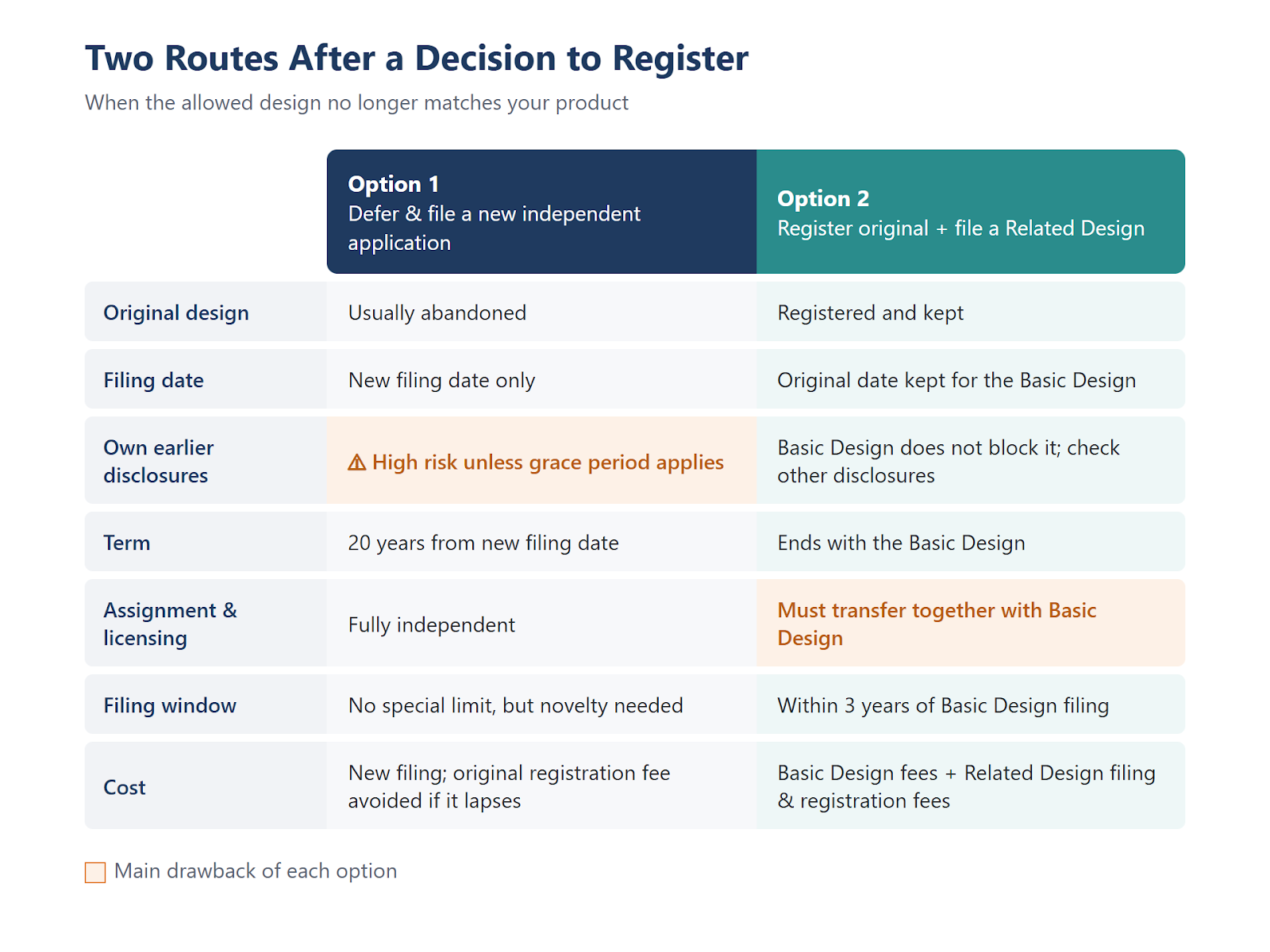
- Status of the original design: Option 1: usually abandoned. Option 2: registered and kept.
- Effective filing date for protection: Option 1: the new filing date only. Option 2: the original filing date for the Basic Design, plus protection for the modified design.
- Effect of your own earlier disclosures: Option 1: high risk unless the grace period applies. Option 2: the Basic Design itself does not block the Related Design. Other disclosures should still be checked carefully.
- Term: Option 1: 20 years from the new filing date. Option 2: ends with the Basic Design.
- Assignment and licensing: Option 1: fully independent. Option 2: must be transferred together with the Basic Design.
- Filing window: Option 1: no special limit, but novelty must still exist. Option 2: within 3 years of the Basic Design's filing date.
- Cost: Option 1: a new filing. The original registration fee can be avoided if that application lapses. Option 2: registration fees for the Basic Design plus filing and registration fees for the Related Design.
How we usually advise clients
In our practice, the right choice depends mainly on three questions:
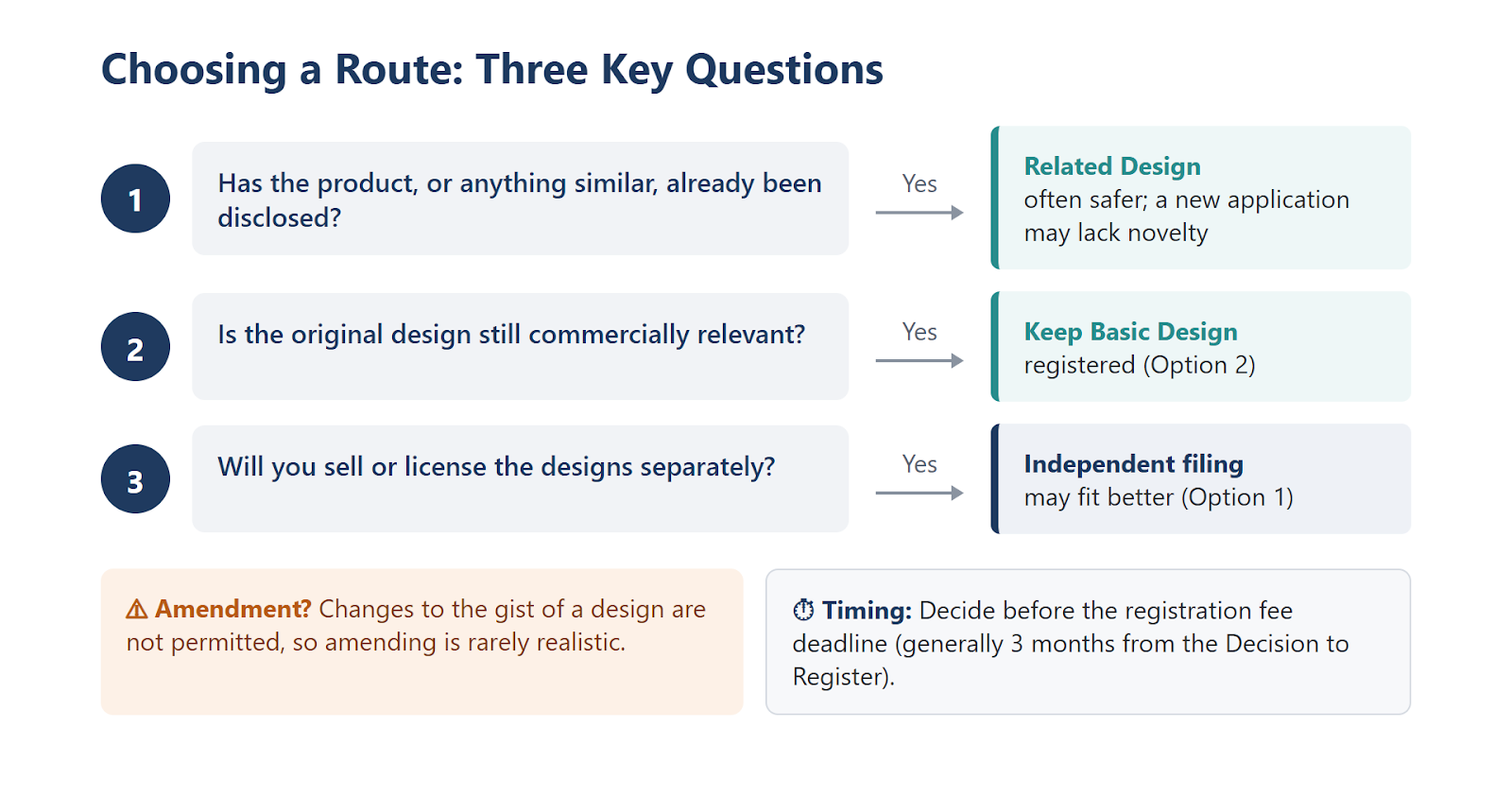
- Has the product, or anything similar, already been disclosed? If yes, a Related Design is often the safer route, because a fresh independent application may lack novelty.
- Is the original design still commercially relevant? If earlier versions or imitations close to the original design matter, keeping the Basic Design registered is valuable.
- Do you expect to sell or license the designs separately? If so, the joint-transfer rule for Related Designs may be a real drawback, and independent applications may be the better fit.
Applicants also sometimes ask whether the allowed application can simply be amended to match the new design. Amendments that change the gist of a design are not permitted, and after a Decision to Register the room for amendment is very limited. In most cases, an amendment is not a realistic way to cover a substantially changed product.
Every case depends on its facts, including the degree of similarity, disclosure dates, and business plans. A Korean design attorney should review the specific designs before you decide whether to pay the registration fee or let the application lapse.
Prevention: file when the prototype is (nearly) finished
Many of these problems can be avoided by choosing the right time to file. Our general recommendation is:
File your Korean design application when the prototype is complete or nearly complete, and before any public disclosure.
- Filing too early, while the design is still changing, often means the registered design no longer matches the product actually sold. The result can be extra filings, extra cost, and a weaker right.
- Filing too late, after launches, trade fairs, crowdfunding pages, or social media posts, risks losing novelty. In that case the applicant has to rely on the grace period, which has strict time limits.
- Filing at the finished-prototype stage gives the best balance. The design you register is the one you sell, and you still file before disclosure.
- If more changes are likely, consider filing the main design together with a few expected variations, or planning Related Design filings within the 3-year window from the start.
Conclusion
When an allowed Korean design no longer matches your product, both deferring registration to refile and registering the original with a Related Design are legitimate strategies. They differ in filing date, novelty risk, term, and transferability, so the choice should be made before the registration fee deadline passes.
BEONE IP, led by Patent Attorney Jungwan Hong in Seoul, handles Korean design, patent, and trademark filings for overseas companies and IP firms. If you are facing a similar situation, feel free to contact us using the form below.
Contact BEONE IP
Have a question about patent, trademark or design protection in Korea? Send us a message below. We usually reply within 1-2 business days (KST, UTC+9).
If the form does not load, please open it in a new window.

댓글 없음:
댓글 쓰기