
The Challenge: Navigating B2B and B2G Barriers in Korea
For early-stage technology companies and foreign startups, breaking into the business-to-business (B2B) and business-to-government (B2G) sectors in South Korea presents significant hurdles. Both corporate procurement departments and public sector institutions operate within structured, risk-averse environments that demand verifiable credibility, rigorous compliance, and crystal-clear value propositions.
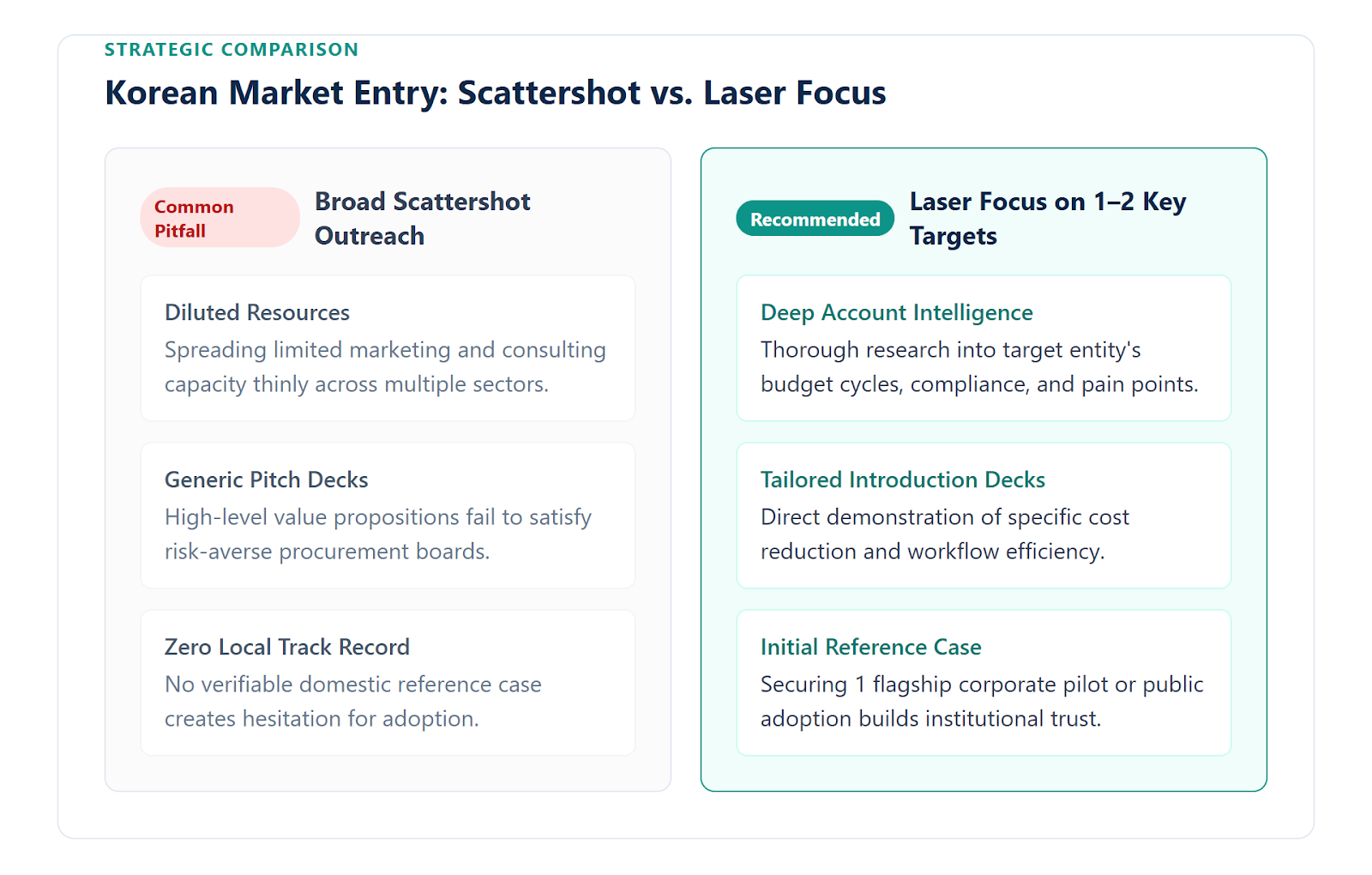
A common mistake many emerging companies make is spreading their limited marketing resources too thin. By trying to address numerous potential clients and government agencies all at once with a generic pitch, startups often dilute their message and fail to gain traction in any single vertical.
Strategy 1: Laser Focus on 1–2 Key Targets First
In our consulting practice advising startups looking to establish commercial footholds in Korea, we emphasize moving away from broad, scattershot marketing. Instead, the most effective approach is to concentrate all initial efforts on just one or two well-defined targets.
- Build a Reference Case: In the Korean market, past performance and institutional trust carry enormous weight. Securing a single pilot project or adoption with one notable corporate partner or municipal agency establishes immediate credibility.
- Conserve Resources: Deeply researching the regulatory constraints, budget cycles, and decision-making structures of one specific entity is far more manageable and impactful for a lean team than superficial outreach across multiple industries.
Strategy 2: Develop Direct, Tailored Introduction Materials
Generic corporate brochures or high-level pitch decks rarely succeed in Korean B2B and B2G procurement. Decision-makers require concise documentation showing precisely how your product or service solves their exact problem.
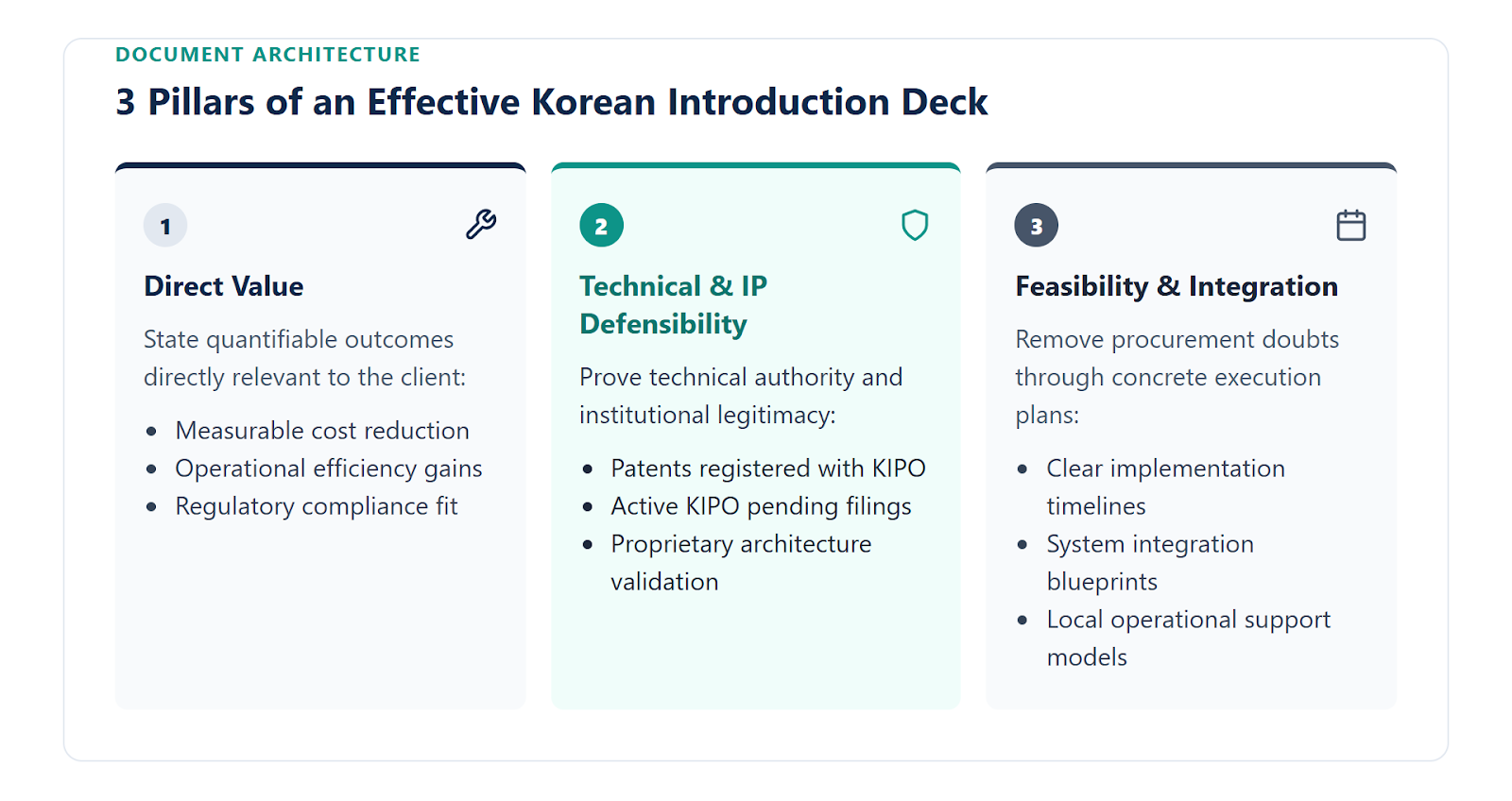
To win initial buy-in, startups must create targeted service introduction decks that directly address the specific operational pain points of the prospective client. Key elements to include:
- Direct Problem-Solving Value: Explicitly state the immediate efficiency, cost reduction, or compliance benefit your solution delivers to that specific organization.
- Technical and IP Substantiation: Government bodies and corporate enterprises will evaluate the defensibility and legitimacy of your technology. Highlighting registered patents or pending patent applications before the Korean Intellectual Property Office (KIPO) significantly strengthens institutional confidence.
- Feasibility and Integration: Provide clear timelines, implementation models, and post-deployment support structures tailored to Korean operational standards.
Strategy 3: Phased Expansion Based on Validated Success
Once you successfully engage and deliver results for your initial one or two accounts, your expansion strategy should scale outward. Having verified references in Korea allows you to approach similar public bodies or enterprise competitors with proven case studies, significantly shortening subsequent sales cycles.
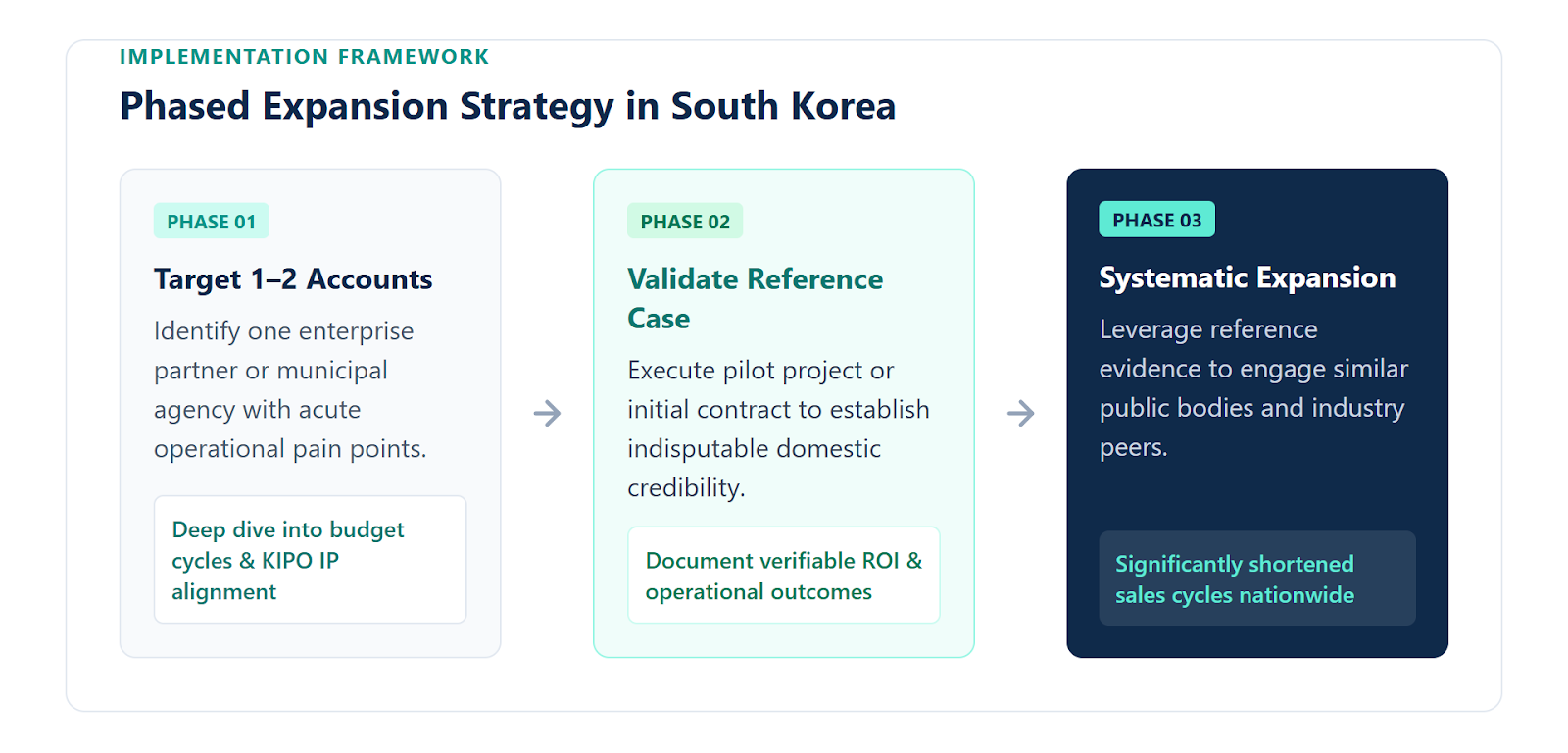
Key Takeaway: Do not attempt to conquer the entire market on day one. Focus your energy on winning over one or two core stakeholders with highly tailored materials, prove your value, and use that foundation to expand systematically across Korea.
Every commercial strategy in Korea involves specific regulatory, corporate, and intellectual property considerations. For customized guidance regarding IP protection, patent portfolio alignment, and market entry strategies in Korea, feel free to contact us using the form below.
Contact BEONE IP
Have a question about patent, trademark or design protection in Korea? Send us a message below. We usually reply within 1-2 business days (KST, UTC+9).
If the form does not load, please open it in a new window.

댓글 없음:
댓글 쓰기